+86-18816569813
 EN

A tractor gearbox housing may operate for thousands of hours under vibration and fluctuating loads, while a wheel hub or implement bracket may experience sudden impacts when agricultural equipment travels over uneven ground. Although these components belong to the same machine, they do not necessarily require the same casting material.
For agricultural machinery manufacturers, ductile iron vs cast steel is therefore an engineering and procurement decision rather than a simple comparison of material strength. Ductile iron can offer an attractive combination of castability, strength, machinability and cost. Cast steel may be preferable where greater structural toughness, demanding impact performance or specific heat-treatment requirements are involved.
This guide compares both materials for gearbox housings, wheel hubs, brackets and other agricultural machinery components. It explains how loading, section thickness, material standards, machining and inspection requirements influence the final choice.
QUICK ANSWER
Choose ductile iron as an initial candidate for many cast agricultural housings, hubs and brackets where strength, machinability and production economics must be balanced. Evaluate cast steel when the part has particularly demanding impact, structural or approved welding requirements. Neither material is universally better: the final grade must be checked against actual loading, fatigue, temperature, geometry and the applicable specification.
1. Ductile Iron vs Cast Steel: Key Differences for Agricultural Equipment
The primary difference lies in the material structure and how each grade responds to loading.
Ductile iron, also called nodular or spheroidal graphite iron, contains graphite in a substantially spherical form. This helps it withstand tensile and bending loads more effectively than conventional gray iron. Depending on the grade and metallic matrix, ductile iron can provide different combinations of strength, elongation and hardness.
Cast steel has a different microstructure and typically relies on its composition and heat-treatment condition to achieve the required mechanical properties. Carbon and alloy steel casting grades can be specified for different strength, toughness and service requirements.
| Comparison Factor | Ductile Iron | Cast Steel |
|---|---|---|
| Material Structure | Spheroidal graphite within a metallic matrix. | Steel microstructure influenced by composition and heat treatment. |
| Strength | Good strength across multiple grades; properties depend on matrix and section size. | Wide range of carbon and alloy grades for different structural requirements. |
| Impact Toughness | Can be suitable for impact loading when the grade, temperature and requirements are appropriate. | Often considered for demanding impact service, subject to specified toughness and testing. |
| Machinability | Often favorable, depending on hardness and ferritic or pearlitic structure. | Depends on alloy composition, hardness, heat treatment and casting condition. |
| Welding or Repair | Requires special procedures and careful control. | May offer more welding options for suitable grades, but procedures and qualifications remain essential. |
| Cost Considerations | Often competitive for suitable cast components and recurring production. | May involve different melting, heat-treatment, machining and examination costs. |
The comparison should not be interpreted as a universal material ranking. A well-designed ductile iron housing may outperform a poorly specified steel casting in its intended application, while a properly specified steel casting may be necessary for a more demanding structural load case.
2. Which Material Should Be Used for Different Farm Machinery Parts?
Material selection becomes more useful when the discussion starts with the actual component rather than the material family. A tractor transmission housing, a wheel hub and a cultivator bracket carry loads differently and therefore require different engineering checks.
Tractor Gearbox and Transmission Housings
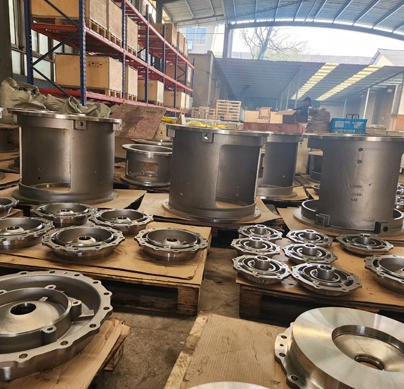
Gearbox housings locate bearings, support shafts, maintain gear alignment and contain lubricating oil. Their performance is influenced by stiffness, mounting loads, vibration, casting soundness and the accuracy of machined bearing seats.
Ductile iron is worth evaluating when the housing must withstand significant bending or shock while maintaining good castability and machining characteristics. Cast steel may be considered for more demanding structural loading or where the approved design requires a steel casting grade.
However, gray iron remains a legitimate option for many transmission housings, especially where vibration damping, stiffness and economical machining are important. An existing gray iron design should not be changed to ductile iron or cast steel without considering the entire assembly.
Important drawing features: Bearing bore alignment, flange flatness, shaft-center distances, sealing faces, internal cavities, mounting rigidity and critical wall sections.
Tractor Wheel Hubs and Axle-Related Components
Wheel hubs experience wheel loads, radial and axial forces, braking torque and fluctuating field conditions. Bearing seats and bolted connections create local areas where dimensional accuracy and fatigue performance matter.
Ductile iron may provide an effective balance of strength and casting economy for properly designed hubs. Cast steel may be evaluated where load severity, impact, fatigue requirements or the approved component specification demand different material performance.
The choice should not be based on tensile strength alone. Hub design must also consider fillet radii, load paths, bolt-hole geometry, bearing fits and the potential for local stress concentration.
Cultivator Brackets, Mounting Supports and Implement Carriers
Agricultural brackets may be subjected to bending, vibration and unexpected overload when attachments encounter stones, compacted soil or obstacles. The most critical location is often a fillet, mounting hole or transition between thick and thin sections.
Ductile iron can be considered for complex brackets where the specified grade provides sufficient strength and elongation. Cast steel becomes an important alternative when repeated impact, demanding toughness requirements or a specific structural design justifies it. Some bracket designs may also be better suited to fabrication or forging rather than casting.
Plow, Harrow and Soil-Contact Components
Soil-contact components face abrasive particles, occasional impact and variable loading. For these parts, the choice is not always a straightforward comparison between ordinary ductile iron and ordinary cast steel.
The required wear mechanism, hardness, toughness and replacement interval must be defined. Depending on the part, an appropriate alloy steel, wear-resistant material or surface treatment may be necessary. High hardness alone does not guarantee superior field performance.
3. Agricultural Casting Material Selection Matrix
The following table offers initial engineering directions, not substitute materials that can be approved without component validation.
| Component | Initial Material Direction | Most Important Evaluation |
|---|---|---|
| Gearbox Housing | Gray or ductile iron; cast steel for selected demanding designs. | Stiffness, bearing alignment, shock loads, vibration and machining. |
| Wheel Hub | Ductile iron or specified cast steel. | Fatigue, bending, bearing fits and bolt-hole stresses. |
| Mounting Bracket | Ductile iron or cast steel, subject to overload requirements. | Impact, stress concentration, fillet geometry and elongation. |
| Implement Carrier | Ductile iron or approved structural steel casting. | Cyclic loading, structural stiffness and connection integrity. |
| Soil-Contact Wear Part | Wear-specific material selection, potentially including alloy steel. | Abrasive wear, impact, hardness, toughness and replacement interval. |
4. Which Material Standards Should Agricultural Machinery Buyers Specify?
A purchase order that specifies only "ductile iron" or "cast steel" leaves important engineering questions unanswered. Different grades can have substantially different strength, elongation, hardness and heat-treatment requirements.
Ductile Iron: ASTM A536
ASTM A536 covers ductile iron castings and defines grades according to tensile strength, yield strength and elongation requirements.
For example, Grade 65-45-12 indicates minimum values of 65 ksi tensile strength, 45 ksi yield strength and 12% elongation under the applicable standard test conditions. A higher-strength grade does not automatically provide better elongation or impact performance.
Cast Steel: ASTM A27 and ASTM A148
ASTM A27/A27M addresses carbon steel castings for general applications, while ASTM A148/A148M covers high-strength steel castings for structural purposes.
The appropriate casting specification depends on service conditions and required mechanical performance. An alloy steel designation used for wrought bar or forging should not automatically be treated as an equivalent casting grade.
Do Not Compare Grade Numbers Directly
A ductile iron grade and a cast steel grade with similar nominal tensile strength are not necessarily interchangeable. Their elongation, fracture behavior, fatigue performance, test specimens, heat-treatment conditions and inspection requirements may differ. Any substitution requires engineering review and customer approval.
5. Machining Differences: Gearbox Bores, Hub Seats and Mounting Faces
For agricultural machinery OEMs, casting cost is only part of the finished component cost. Gearbox housings, wheel hubs and brackets commonly require machining after casting, and the selected material affects cutting conditions and tool performance.
Ductile iron machinability depends on whether its matrix is mainly ferritic, pearlitic or heat-treated. A ferritic grade may machine differently from a harder pearlitic grade. Graphite can assist chip formation, but surface condition and local hardness still influence tool life.
Cast steel machining depends on alloy content, hardness and heat treatment. Certain hardened or high-strength steel castings may require more demanding tooling and machining conditions. Neither material should be assigned a fixed machining-cost advantage without evaluating the actual grade and component.
Machining Features That Affect Agricultural Parts
Bearing bores: Diameter, roundness, coaxiality and surface finish influence shaft alignment.
Mounting faces: Flatness and perpendicularity help maintain correct assembly positioning.
Bolt holes and threads: Hole placement, thread engagement and local material strength affect connection reliability.
Casting allowances: Raw castings must retain enough material for required finishing operations.
Balasen's custom machining services provide a related manufacturing route. For more detail on machining stock, see the casting machining allowance guide.
6. Ductile Iron vs Cast Steel Cost: Compare the Finished Part
Ductile iron is often an economical starting point for suitable agricultural machinery castings, but it is inaccurate to claim that ductile iron is always cheaper than cast steel by a fixed percentage.
The cost difference depends on casting size, foundry process, alloy grade, tooling, heat treatment, machining, inspection and order quantity. A steel casting with extensive machining or examination can have a different cost profile from a relatively simple ductile iron casting. Conversely, a specialized ductile iron grade with demanding acceptance requirements may be more expensive than expected.
Compare These Five Costs During Sourcing
Tooling and casting blanks: Pattern, mold or core tooling and raw casting price.
Heat treatment: Any required treatment to achieve the specified material condition.
Machining: Bore finishing, face milling, drilling, tapping and other operations.
Inspection: Mechanical testing, dimensional measurement and specified NDT.
Service life: Field failure, downtime, replacement and warranty exposure.
For procurement teams, the more useful metric is the cost of an accepted, machined component that meets the design's service-life requirements—not simply the lowest casting price per kilogram.
7. Common Material Selection Mistakes in Agricultural Castings
Mistake 1: Selecting by Tensile Strength Alone
Tensile strength does not fully describe fatigue, impact response, fracture behavior or local stress concentration. A bracket that experiences repeated bending should be evaluated for the actual load spectrum, not only its minimum tensile-strength requirement.
Mistake 2: Ignoring Section Thickness
A material grade achieved on a test specimen does not guarantee identical properties at every location of a thick casting. Solidification, cooling and heat-treatment response can vary with geometry. Heavy bosses and thick-to-thin transitions deserve special review.
Mistake 3: Treating a Casting as a Drop-In Material Replacement
Replacing ductile iron with cast steel, or vice versa, without validating the design can change the component's weight, stiffness, machining behavior and response to fatigue. The replacement must be approved against the intended load cases.
Mistake 4: Overlooking Corrosion and Field Conditions
Mud, moisture, fertilizers, road salts and prolonged storage can affect exposed agricultural components. Material selection must be considered together with coating, drainage, corrosion protection and maintenance requirements.
Mistake 5: Assuming That Harder Means Longer-Lasting
Hardness may be relevant to abrasion, but high hardness can involve trade-offs in toughness. A soil-contact part exposed to repeated impacts must be evaluated for both wear and cracking risk.
8. Inspection Requirements for Ductile Iron and Cast Steel Parts
Material certificates alone do not verify every aspect of an agricultural machinery casting. An appropriate inspection plan should connect material testing, critical dimensions and the component's actual service requirements.
| Inspection Area | What Buyers Should Request |
|---|---|
| Material Identification | Confirmed material standard, grade and applicable chemical analysis. |
| Mechanical Properties | Tensile, yield, elongation, hardness and any specified impact testing. |
| Ductile Iron Microstructure | Nodularity, graphite and matrix examination where contractually required. |
| Casting Soundness | Visual examination and suitable nondestructive methods if specified. |
| Finished Dimensions | Approved datum scheme, critical tolerances, bearing interfaces and inspection reports. |
For high-duty hubs or brackets, special attention may be needed at fillets, mounting holes and other highly stressed regions. Examination methods, test locations, sampling frequency and acceptance levels should be agreed before production. Not every test is automatically included in a standard casting quotation.
9. A Practical Material Selection Checklist for Agricultural Machinery OEMs
Before specifying ductile iron or cast steel, use the following sequence to reduce uncertainty during design review and supplier quotation.
01 — Identify the Component's Load Case
Is the part primarily exposed to static loads, bending, fatigue, impact, vibration or abrasion?
02 — Review Geometry and Critical Sections
Check wall thickness, fillets, mounting holes, ribs, internal cavities and machining allowances.
03 — Define the Actual Material Specification
Specify the relevant ductile iron or cast steel standard, grade, condition and minimum required properties.
04 — Compare the Finished Component Cost
Evaluate tooling, casting blanks, heat treatment, machining, inspection and the expected production quantity.
05 — Confirm Testing and Engineering Approval
Agree on inspection criteria and validate any material change before approving the production drawing.
For manufacturing enquiries, Balasen's agricultural machinery casting page provides the relevant application entry point. Buyers can also review ductile iron castings and alloy steel casting options before submitting their drawings.
Frequently Asked Questions
1. Is ductile iron better than cast steel for tractor gearbox housings?
Not universally. Ductile iron may offer an attractive balance of strength, machining and cost. Cast steel may be more appropriate for certain demanding structural requirements. Gray iron also remains suitable for many gearbox housings, depending on the approved design.
2. Can ductile iron be used for agricultural wheel hubs?
Yes, where the component design, material grade and loading requirements permit it. Bearing fits, fatigue, bending, bolted connections and inspection requirements must be checked before approval.
3. Is cast steel always more impact-resistant than ductile iron?
No. Impact performance is grade- and condition-dependent. Some ductile iron grades can provide useful toughness, while cast steel properties vary with composition and heat treatment. Required impact values and service temperature should be specified.
4. Which material is cheaper for agricultural castings?
Ductile iron is often competitive for suitable cast parts, but cost depends on the specific grade, weight, tooling, machining, heat treatment, quantity and inspection. Compare finished-part quotations rather than material price alone.
5. What is the difference between ASTM A536 and ASTM A148?
ASTM A536 covers ductile iron castings. ASTM A148/A148M covers high-strength steel castings for structural purposes. The two standards define different materials and acceptance requirements and are not direct substitutes.
6. Can an existing ductile iron part be changed to cast steel?
A material change can be evaluated, but it must be approved through engineering review. Strength, stiffness, fatigue, casting geometry, machinability, assembly interfaces and inspection may all be affected.
7. What matters most for agricultural parts exposed to abrasion?
The dominant wear mechanism, impact severity, material hardness, toughness and surface condition should be identified. Neither ordinary ductile iron nor ordinary cast steel is automatically the best material for every abrasive application.
8. What should an OEM send to request a casting quotation?
Provide a controlled drawing, material grade, estimated weight, batch and annual quantity, service conditions, machining requirements, critical tolerances, inspection criteria and delivery destination.
Conclusion: Select by Component Function, Not Material Reputation
For agricultural machinery, the choice between ductile iron and cast steel should be made at the component level. Ductile iron is often a strong initial candidate for housings, hubs and brackets that need an effective balance of casting performance and cost. Cast steel deserves closer evaluation where structural demands, toughness or a particular design specification justify it.
The final decision depends on the approved load case, grade, geometry, heat treatment, machining and inspection requirements. A well-defined engineering drawing and acceptance plan are more valuable than simply requesting the strongest available material.
AGRICULTURAL CASTING PROJECT REVIEW
Need Help Reviewing a Ductile Iron or Cast Steel Part?
Balasen supports custom metal casting enquiries for agricultural machinery applications. Share your gearbox housing, hub, bracket or other component drawing together with the specified material, order quantity, machining and inspection requirements. Our team can review the requested manufacturing scope and discuss casting feasibility.
Email:sales@balasen.com