+86-18816569813
 EN
An OEM sourcing a stainless steel valve component may choose investment casting to achieve complex geometry without extensive machining. Meanwhile, a manufacturer producing thousands of identical aluminum housings may find high-pressure die casting more economical after the initial tooling investment.
Both processes can produce near-net-shape metal parts, but their production methods, material limitations and cost structures are substantially different. Choosing between investment casting vs die casting requires more than comparing surface finish or dimensional accuracy.
This guide examines the key differences in tooling costs, production quantities, alloy compatibility, design flexibility, machining requirements and casting inspection. It is intended to help industrial buyers select a suitable manufacturing process before requesting quotations.
QUICK ANSWER
Investment casting is often preferable for complex stainless steel, carbon steel and selected alloy components where material flexibility and near-net-shape geometry matter. High-pressure die casting is frequently attractive for high-volume aluminum, zinc and magnesium parts where fast repeatable production can offset more expensive tooling. The best choice depends on the alloy, drawing, production quantity and total finished-part cost.
1. Investment Casting and Die Casting: How Do the Processes Differ?
The fundamental difference is the mold. Investment casting typically produces each metal part inside an expendable ceramic mold built around a wax pattern. High-pressure die casting injects molten metal into a reusable steel die.
EXPENDABLE CERAMIC MOLD
Investment Casting
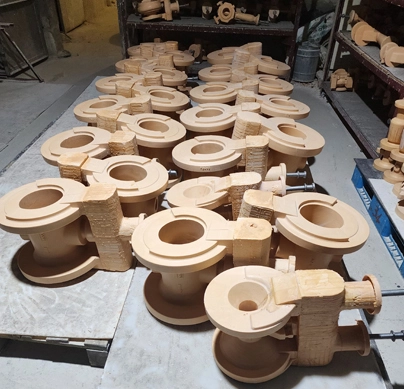
Wax patterns are produced and assembled into clusters. A ceramic shell is built around the patterns using repeated slurry and refractory coating operations.
Wax Pattern
↓
Ceramic Shell Building
↓
Dewaxing and Metal Pouring
↓
Shell Removal and Finishing
Each ceramic mold is broken away after casting. Wax-pattern tooling may still be reusable for subsequent production batches.
REUSABLE STEEL DIE
High-Pressure Die Casting
Molten metal is injected into a reusable steel die under high pressure. The metal solidifies inside the die, which then opens to release the casting.
Prepare and Close the Steel Die
↓
Inject Molten Metal
↓
Solidify Under Controlled Conditions
↓
Eject the Part and Repeat
The same steel die can produce many castings, subject to alloy, maintenance, thermal fatigue and tool life.
Investment casting involves wax-pattern production, ceramic shell building, drying, dewaxing, pouring and shell removal. These additional operations influence manufacturing time and labor requirements. High-pressure die casting can achieve much shorter machine cycles, but requires sophisticated tooling and specialized production equipment.
For technical process references, see the Investment Casting Institute's ceramic shell explanation and the North American Die Casting Association's process FAQ.
2. Investment Casting vs Die Casting: Side-by-Side Comparison
For industrial buyers, the most important differences are material compatibility, initial tooling investment, batch economics and the finished condition of the component.
| Comparison | Investment Casting | High-Pressure Die Casting |
|---|---|---|
| Mold System | Expendable ceramic shell around a wax pattern. | Reusable precision steel die. |
| Common Materials | Stainless steel, carbon steel, selected alloy steels and suitable nonferrous alloys. | Commonly aluminum, zinc and magnesium alloys. |
| Initial Tooling | Wax-pattern tooling; cost depends on complexity and quantities. | Typically higher investment in steel dies and associated tooling. |
| Production Volume | Can suit prototypes, small batches and recurring production depending on tooling and process. | Often economical at higher volumes with stable part designs. |
| Geometric Complexity | Can form intricate surfaces and selected complex shapes through the wax-pattern route. | Complexity is influenced by draft, die parting, sliders, cores and ejection. |
| Dimensional Accuracy | Potentially close-to-finished geometry, subject to size and process capability. | High repeatability for suitable die and alloy combinations. |
| Typical Cost Driver | Wax patterns, ceramic shells, melting, finishing and inspection. | Die investment, cycle time, machine utilization and tool maintenance. |
| Primary Sourcing Question | Can this alloy and geometry be cast with acceptable finishing cost? | Will the annual volume justify tooling and production investment? |
3. Material Limitations: Why Steel Castings Usually Follow a Different Route
Material selection can eliminate one process before tooling costs are even considered.
Stainless Steel and Carbon Steel Components
Conventional high-pressure die casting uses reusable metal dies and is primarily associated with nonferrous alloys. Producing ordinary steel castings through the same high-pressure die casting route is generally impractical because of high processing temperatures and the demands placed on the die materials.
Investment casting is therefore an important option for stainless steel valve components, carbon steel precision parts and selected alloy steel components requiring detailed cast geometry. Its ceramic mold system allows the process to be adapted to different casting alloys, provided that melting, shell materials and solidification requirements are appropriately controlled.
For related production capabilities, explore Balasen's investment casting services and stainless steel casting material page.
Aluminum, Zinc and Magnesium Parts
For large production runs of nonferrous housings, covers, brackets and similar products, die casting can offer considerable advantages. Reusable steel dies and fast production cycles make the process attractive when the geometry and alloy are suitable.
Investment casting can also be used with certain nonferrous alloys, but an investment casting quote should not automatically be considered competitive with high-volume die casting. The correct comparison depends on the selected alloy, required geometry, batch size and the cost of the finished part.
What About Copper Alloys and High-Temperature Alloys?
Specialized pressure die casting processes exist for some copper alloys, although they are less common than aluminum and zinc die casting. Investment casting can also be engineered for certain high-temperature alloys, but successful production depends on specialized melting, ceramic shell and inspection capability. These materials should never be assumed available from a particular foundry without grade-specific confirmation.
Procurement Rule: Confirm the Alloy Before Comparing the Process
Start with the actual material specification, not a broad label such as "steel," "aluminum" or "bronze." The casting grade, required properties, heat treatment and acceptance standards determine which processes can realistically meet the engineering requirements.
4. Tooling Costs: When Does Die Casting Become More Economical?
Tooling economics are among the most important differences between investment casting and die casting. The lowest per-piece casting price does not necessarily mean the lowest total project cost.
Investment Casting Tooling
For recurring investment casting orders, reusable tooling may be manufactured to inject wax patterns. Each wax pattern is later surrounded by an expendable ceramic mold. The tooling investment can be lower than a comparable high-pressure die, but wax production, ceramic shell building, drying and finishing create recurring process costs.
This structure can be attractive for complex parts, design revisions and quantities that do not justify a large die casting investment. However, complex wax tooling can also be expensive. Investment casting is not a universally low-tooling-cost process.
High-Pressure Die Casting Tooling
High-pressure die casting tooling is designed for repeated injection and ejection cycles. A steel die may include cooling channels, gates, ejector systems, inserts and moving features. More complicated parts can require additional slides or mechanisms to form their geometry.
These features increase initial investment. However, when production quantity is sufficiently high, the tooling cost can be distributed across many parts, and a faster production cycle may reduce the manufacturing cost per acceptable component.
COST COMPARISON METHOD
Compare Total Accepted-Part Cost
Total Project Cost =
Tooling + Production + Finishing + Inspection + Rework/Scrap + Logistics
To compare quotations, ask both suppliers to use the same drawing revision, material grade, finished condition, inspection scope and required production quantity.
If die casting requires greater initial tooling investment but offers a lower recurring cost per acceptable part, its economic advantage depends on production volume. There is no reliable universal break-even quantity for every alloy and component.
5. Production Volume: Small Batches vs High-Volume Manufacturing
A common sourcing mistake is to compare a single casting quotation without considering the annual demand or expected product life.
Prototype and Early Development
Investment casting can be considered for prototypes and early production when the selected alloy and geometry are suitable. Depending on the project, alternative pattern production methods may reduce the need for conventional production tooling. Costs and dimensional results still require evaluation.
Small and Medium Recurring Batches
Investment casting can be attractive when part complexity, material requirements or recurring quantities justify wax tooling and ceramic shell production. An accurate annual forecast helps the foundry select tooling and production arrangements.
High-Volume Stable Production
For large quantities of identical aluminum, zinc or magnesium components, high-pressure die casting often deserves evaluation. Stable designs and sufficient production demand help justify reusable steel dies and specialized equipment.
The critical variables are total lifecycle volume, part complexity, tooling life, production yield and expected design changes. A high-volume product with frequent design revisions may still face expensive die modification costs.
6. Complex Geometry, Wall Thickness and Machining Requirements
Both processes can create detailed components, but they face different design restrictions.
Undercuts and Internal Cavities
Investment casting allows a wax pattern to reproduce intricate external surfaces. Certain complex geometries can be formed through specialized tooling and core techniques, but not every internal channel or undercut can be cast without additional process development.
Die casting design must account for the reusable die's opening direction and the part's ejection. Slides, movable cores and inserts can expand design possibilities, but also increase tooling complexity, cost and maintenance.
Thin Walls and Section Changes
Neither process guarantees that every thin wall will fill successfully. Investment casting requires consideration of alloy fluidity, ceramic shell condition, metal temperature and feeding. High-pressure die casting requires careful attention to metal flow, venting, wall transitions and cooling.
The achievable minimum wall thickness must be confirmed for the actual alloy and geometry. It should not be selected from a generic process comparison table alone.
Which Features Still Require CNC Machining?
Near-net-shape production can reduce machining, but precision bearing bores, threads, mounting faces and sealing surfaces may still need finishing. Both casting processes should be evaluated against the final assembly drawing.
Do Not Compare As-Cast Tolerances with Finished-Part Tolerances
A tolerance that can be achieved on an as-cast feature may differ substantially from the tolerance required on a machined bore or sealing face. Buyers should identify critical dimensions, datums, surface finish and inspection methods before using a general CT grade or roughness value as a procurement requirement.
For further technical considerations, see Balasen's custom machining services.
7. Casting Quality: Porosity, Inspection and Functional Requirements
An investment casting and a die casting may appear equally smooth after finishing while having different internal quality characteristics. Surface appearance alone does not demonstrate that either casting meets pressure, fatigue or structural requirements.
Investment Casting Quality Risks
Possible issues include misruns, shrinkage, inclusions, shell-related defects and dimensional variation. Appropriate shell building, metal feeding and inspection are required to control these risks.
Die Casting Quality Risks
Potential risks include gas entrapment, porosity, incomplete filling, cold shuts and dimensional variation. Proper gating, venting and process control matter. Specialized high-integrity die casting methods can address some of these issues.
For pressure-containing parts, buyers should specify the required leakage or pressure testing. For fatigue-sensitive parts, material properties and internal discontinuity acceptance criteria may be particularly important. No casting process should be treated as inherently pressure-tight or defect-free.
Inspection requirements may include chemical analysis, mechanical testing, dimensional inspection, radiographic examination, liquid penetrant inspection or other tests, depending on the alloy and application. The method, extent of inspection and acceptance limits should be agreed before production.
8. Industrial Part Examples: Which Casting Method Fits?
The following hypothetical sourcing scenarios show how material and volume can change the manufacturing decision. They are engineering examples, not claims of completed Balasen customer projects.
APPLICATION 01
Stainless Steel Valve Components
A buyer requires stainless steel components with defined corrosion resistance, complex external features and selected machined sealing surfaces. Investment casting may offer a suitable route because conventional high-pressure die casting is not normally used for stainless steel.
Key checks: Alloy grade, casting geometry, corrosion requirements, machining and inspection.
APPLICATION 02
High-Volume Aluminum Electronics Housing
A manufacturer needs large quantities of identical aluminum enclosures with mounting features and a stable long-term design. High-pressure die casting may be attractive because recurring production can offset the investment in a reusable steel die.
Key checks: Annual demand, draft angles, die design, alloy and total tooling cost.
APPLICATION 03
Complex Carbon Steel Industrial Bracket
An OEM requires a carbon steel component with multiple structural features and specified mechanical properties. Investment casting may be evaluated if the geometry, weight and material grade suit the process. A sand casting route may also deserve consideration depending on size and tolerance.
Key checks: Steel grade, structural load, part weight, heat treatment and production quantity.
APPLICATION 04
Small Zinc Hardware Component
A hardware manufacturer plans repeat production of a small zinc alloy part with a stable design and high annual quantity. Die casting may be well suited to this type of project because of its ability to reproduce small parts efficiently.
Key checks: Die complexity, production quantity, surface finish and assembly requirements.
APPLICATION 05
Industrial Pump Components with Complex Geometry
A pump manufacturer needs a complex metal part with defined material properties and machined functional interfaces. Investment casting may be a candidate for suitable sizes and materials, while sand or shell molding could be more appropriate for other dimensions and volumes.
Key checks: Material grade, internal geometry, machining access, inspection and order quantity.
For related application information, see Balasen's pump and valve casting page.
9. How to Choose Between Investment Casting and Die Casting
Before requesting quotations, a procurement or engineering team should answer five questions.
01. Which Alloy Is Actually Required?
Confirm the material grade and the performance requirements. Stainless steel and carbon steel generally point toward foundry processes such as investment casting rather than conventional high-pressure die casting.
02. How Many Parts Will Be Needed?
Define prototype quantity, initial batch size, annual demand and expected lifetime production. Do not compare quotations based on the first order alone.
03. Does the Part Require Complex Features?
Review wall thickness, internal cavities, undercuts, draft, parting lines and machining access. Some shapes may need additional cores or tooling regardless of the process.
04. What Must Be Machined or Inspected?
Identify critical dimensions, sealing faces, threads, mechanical tests and required NDT. The true comparison is the cost of a conforming finished component.
05. How Stable Is the Product Design?
If revisions are likely, consider tooling modification cost and engineering flexibility. The lowest cost at one production quantity may not remain the best choice after design changes.
10. What Should an OEM Include in a Casting RFQ?
A useful casting quotation requires a consistent engineering scope. If one supplier quotes an as-cast blank while another includes machining, material reports and inspection, their prices are not directly comparable.
If investment casting is being considered, Balasen offers both low-temperature wax casting and medium-temperature wax casting routes. The correct route must be evaluated using the specified alloy, part geometry, pattern requirements and finished-part specifications.
Frequently Asked Questions
1. Is investment casting cheaper than die casting?
Not always. Investment casting often has a lower initial tooling burden for suitable parts, but recurring wax-pattern, ceramic shell and finishing costs can be higher. Die casting may become more economical as production volume increases, provided the material and geometry are compatible.
2. Can stainless steel be manufactured by high-pressure die casting?
Conventional high-pressure die casting is not a standard production route for stainless steel because of the high temperatures and demanding die conditions. Investment casting and other foundry processes are more typical candidates for stainless steel components.
3. Which process is better for complex geometries?
Investment casting is often attractive for intricate features and suitable near-net-shape designs. Die casting can also form complex parts using slides, cores and other tooling features. The actual drawing determines which process is practical and economical.
4. Does investment casting require a metal mold?
Investment casting commonly uses reusable tooling to produce wax patterns. However, the ceramic mold surrounding each wax pattern is expendable and is broken away after metal solidification. This is different from the reusable steel die used in high-pressure die casting.
5. Which process is better for aluminum components?
High-pressure die casting may be advantageous for high-volume aluminum parts with stable geometry. Investment casting can be considered where the geometry, alloy, quantity or other requirements justify it. Total tooling and finished-part costs should be compared.
6. Which casting process has better dimensional accuracy?
Both can provide accurate as-cast features for suitable components. Achievable tolerances depend on part size, geometry, alloy and process control. Critical finished dimensions should be specified individually rather than selecting a process from a generic tolerance claim.
7. Does investment casting eliminate CNC machining?
No. Near-net-shape production can reduce material removal, but functional bores, threaded holes, sealing surfaces and precision mounting features may still require CNC machining.
8. Can Balasen provide die casting services?
Balasen publicly lists investment casting, sand casting, shell casting and other manufacturing services. High-pressure die casting is not listed as a standalone core process. Buyers requiring die casting should request confirmation of the available production route and supplier arrangements rather than assume in-house die casting capability.
Conclusion: Choose the Process That Fits the Material and Business Case
Investment casting and die casting are not direct substitutes for every industrial component. The material grade may determine which process is practical, while part geometry, production quantity and tooling economics determine which option is commercially attractive.
Investment casting is often a useful choice for complex stainless steel and other suitable precision metal components. High-pressure die casting can be highly efficient for large quantities of appropriate nonferrous parts. Neither process should be selected using a single cost, tolerance or surface-finish figure without reviewing the full finished-part requirements.
PRECISION CASTING PROJECT REVIEW
Discuss an Investment Casting Project with Balasen
If your project involves stainless steel or another suitable metal component requiring complex geometry and controlled dimensions, share your drawings, alloy grade, quantity, machining requirements and inspection criteria. Balasen can review the proposed investment casting route and quotation requirements.
Request an Investment Casting QuoteEmail:sales@balasen.com